

On the road with Aaltje and Bort Spakenburg
Summary
What was daily life like a hundred years ago? What did children do back then? What did they look like and how did they live? What was a guilder, and what could you do with it back then? Would you like to travel back in time? "Out and About with Aaltje and Bort" lifts history off the page! Students listen to the story about Aaltje and Bort, two children about their own age. They then interact with the story in various ways: they dress up Aaltje and Bort, learn to work with a family tree, place family photos on a timeline, complete math exercises about time and money, and do chores or games that children played a hundred years ago. This way, they experience firsthand something of life back then. In "Out and About with Aaltje and Bort," the story of Aaltje and Bort is the central theme. It brings history to life and allows children to identify with the two main characters.
Short lesson overview
- Lesson 1 Aaltje and Bort: Students listen to part 1 of the story. They draw Aaltje and Bort's clothes.
- Lesson 2 When did Aaltje and Bort live?: Students work with a timeline.
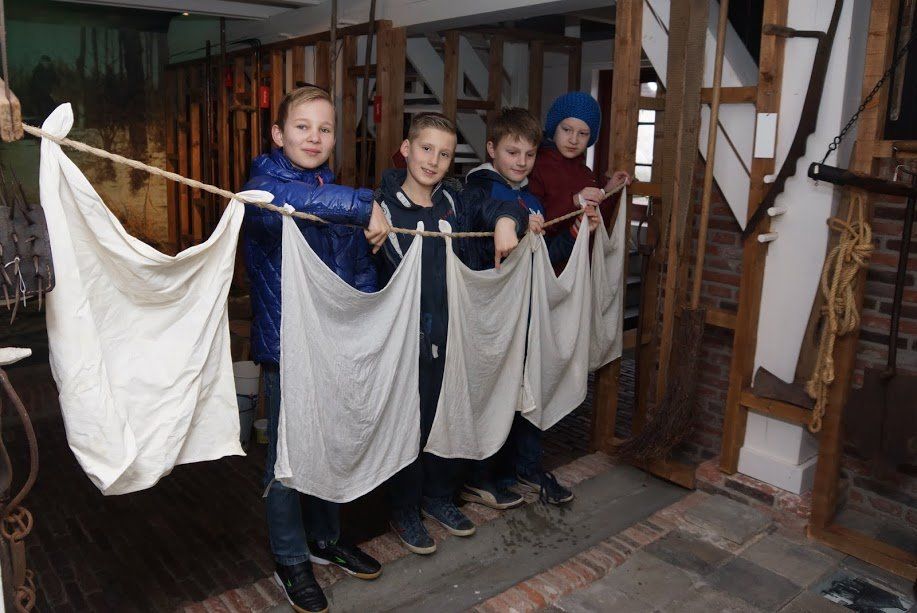
- Lesson 3 Visit to Museum Spakenburg.
- Lesson 4: How did Jet get that guilder?: Students listen to part 2 of the story. They do some math.
Practical information
We use a teaching kit. Inside, you'll find items you can use in lesson 4 after visiting the museum. You'll receive this loan kit for a limited time during your museum visit. The materials have been carefully selected and are used by several schools in succession. Please handle them with care. If any items are missing or damaged, please report this upon return. Contents of the kit:
- 1 Aaltje and Bort game
- 1 picture book by Aunt Pau
- 1 bag with a silver guilder
Teaching material replacement
"Out and About with Aaltje and Bort" aligns with the core objectives for history and the curriculum for grade 5. (Some methods even start with an introduction to the topic as early as grades 3 or 4.) The project can replace some of the material in commonly used history textbooks. In addition to history, the preparation and processing lessons also cover drawing, measuring, arithmetic, composing, reading, and games.